Pages

Showing posts with label Life Insurance. Show all posts

Monday, 11 May 2020

All you need to know about loans against insurance policies

Your LIC policy can do more than just give you an insurance cover. It can be used to raise loans.
The rates at which loans can be taken have been revised early May 2020.
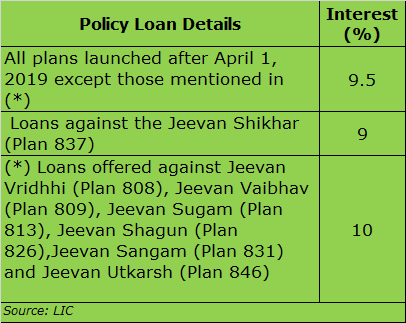
Loans against the policy ‘Jeevan Shikhar’ are available at the lowest rate of 9 per cent. On all other regular premium endowment plans and money-back policies launched after April 1, 2019, loans would come with a 9.5 per cent interest.
“The revised rate will be applicable on the new loans being availed by policyholders and there will be no change in respect of existing loans,” clarifies LIC.But those opting for loan against single premium traditional policies – namely Jeevan Vridhhi (Plan 808), Jeevan Vaibhav (Plan 809), Jeevan Sugam (Plan 813), Jeevan Shagun (Plan 826), Jeevan Sangam (Plan 831) and Jeevan Utkarsh (Plan 846) – would pay the steepest interest rate of 10 per cent annually.
As per the last Annual Report of the company, Rs 1.14 lakh crore have been given out as loans in India, of which 99.98 per cent are given against non-linked policies or traditional policies as on March 31, 2019.
How the loan against insurance policy works
The interest rate offered on loans against insurance policies are lower, at 9-10 per cent, when compared with personal loans that come at a steep cost of 15-18 per cent and Credit Card debt, which costs you 36-52 per cent.
The best part is that the insurance behemoth doesn’t consider the credit worthiness or the CIBIL score as a parameter for offering this loan as it is an advance paid against the policy’s maturity proceeds. However, income proof and bank statements apart from the original policy documents are needed while requesting for a loan.
You can get a loan for up to 90 per cent of the surrender value of a policy, if the premium has been paid for three consecutive years, without any break. Also, these loans are available only for endowment, whole life and money-back policyholders and not for term plans or ULIP customers.
“A policy acquires a wholesome surrender value only after 10-12 years. So, during the early years of a policy, you would hardly be able to apply for a sufficient loan amount,” suggests certified financial planner Pankaaj Maalde.
LIC offers loans against its policies for a minimum period of six months. Firms such as ICICI Prudential Life Insurance, HDFC Life, and Edelweiss Tokio Life too offer loans directly to their traditional insurance policyholders. You also have the option of taking a loan from any bank against the insurance policies, but the interest rate would differ.
“The life insurer or the bank offering a loan against an insurance policy was ask for partial or full assignment of the policy” says Vivek Damani, proprietor of financial advisory Jeevan Prabandhan
As branches in select regions would still be closed during the current lockdown, you can apply for loans against a policies by going online.
How is the interest paid?
While repaying the loan, you can either service the entire loan, including the principal, or merely pay the interest. The rest of the loan principal can be settled from the policy amount at maturity.
“You must always make sure you never miss the interest payment,” Maalde warns, indicating that the policy may be terminated if the total amount outstanding exceeds the surrender value.
If you take a loan against policies offering pension at regular intervals, then the interest would be deducted from the amount that is paid as pension or annuity. Varishtha Pension Bima Yojana (T-828), Pradhan Mantri Vaya Vandana Yojana (T–842) and Jeevan Shanti (T-850) are some such examples.
The loans taken against insurance policies will not qualify for the moratorium that borrowers were given recently by banks to tide over the COVID-19 crisis.
Loans against insurance policies are merely advances against your policies. If you default, the insurance company would simply foreclose your policy and recover its dues.

https://www.moneycontrol.com/news/business/personal-finance/all-you-need-to-know-about-loans-against-insurance-policies-5239821.html

Sunday, 25 February 2018

ULIPs are good, but Mutual Funds are great!

With the LTCG levied on Equity MFs, we are seeing both media and the Insurance Companies saying, ULIP does not have LTCG. This is their new marketing strategy to SELL ULIPS. This clearly is another time when investors will burn their hands at ULIPs and will go away from Equity. 

How many remember the time when ULIPS were just launched and aggressive misselling had happened? It was after a few years when investors realized that this was not the apt investment for them and synonymed ULIPS to Equity.

The MF Industry has already gone through this once where they have had to educate investors, that Mutual Funds are different from ULIPS. This will be a dampener for the MF Industry and the investors at large if awareness about ULIPS and MF with LTCG is not created. This clearly is the new talking point for advisors with new investors. 

Mr. Pankaaj Maalde, CFP shares his views and an outline of his talking points on ULIPS vs. MFs with his investors. Advisors take note!

Charges of the taxes collected on capital gains shouldn’t matter for wealth creators.

From April 1, 2018, new Financial Budget will come into implementation; this can help ULIPs to promote the products where long-term capital gains are not taxed (LTCG). Whereas Capital gains on stock markets and Mutual Funds will be taxed for gains over 1 lac rupees at 10.4% (10% LTCG+4% Cess)    

ULIPs has advantages, but when compared to Mutual Funds, they can’t compound money the way Mutual Funds do. 

Insurance Products are kept out of the ambit of this tax. And maybe this can lead to misselling.  
ULIPS have three major points- 

1.    Allocation Charges every year.
2.    Policy Admin Charges.
3.    Higher Lock-in Period

Stick to mutual funds, invest for long periods to generate wealth. Power of compounding is the best provision here.

Insurance Agents will tell investors that in ULIPS, there are free switches available, without any tax liability. According to me, in practice it is not easy to do that and one should avoid timing the market.

When you look at Mutual funds, they beat the Benchmark and generate good wealth. Also, there is no lock-in period, except ELSS that too three years. Whereas, ULIPs have a minimum lock-in period of 5 years. Mutual funds give diversified portfolio and give the chance to shuffle from one scheme to another. 

I would like to suggest my clients as well as other investors and advisors to continue with Mutual funds if they want long-term benefits. 

Article first appeared at mutualfundlive.com

http://www.mutualfundlive.com/Lounge/Advisor-Viewpoint/ULIPs-are-good--but-Mutual-Funds-Equity-Investments-are-great!/37

Thursday, 6 July 2017

Service tax hike makes traditional plans unviable

Post GST financial sector service tax will go up from 15% to 18%. The service tax on life insurance plans will also go up which is likely to affect the insurance sector badly. The new service tax rate will be 18% for term insurance premium and also for ULIP charges.  Traditional plans service tax will be 4.50% (old rate 3.50%) for the first year and 2.25% (old rate 1.75%) for subsequent years. Hike in service tax is a major blow to small investors. These increases in service tax will not increase the premium but also will reduce the overall return in traditional plans.

Traditional insurance plans are sold heavily historically since LIC came into existence. Previously only LIC was pushing for these products but now private insurance companies are also aggressively selling traditional plans. Traditional plans are nothing but combination of insurance cover and saving element coupled with tax benefit u/s 80-C.  Traditional plans are very easy to sell as they are not complex compared to ULIPs where performance of the fund is linked market conditions.

We need to agree that insurance distribution is agents driven. The agents sell only those products where they earn more commission. Agents are promoting traditional plans heavily only because traditional plans pay around 35% commission in 1st year and 5% from 2nd year onward as renewal commission till the premiums are paid.  

I strongly feel that the annual returns on the traditional plans will come down to around 5% p.a. Actually traditional insurance plans are neither insurance plans as they offer very limited sum assured against the premium paid nor are they investment products, as they are unlikely to beat the inflation in long run. It is much better to take a term plan and invest balance in PPF or Sukanya Samridhi Scheme as both also give tax benefit and maturity is also tax free like insurance plans. This combination of term and PPF/SSS will give 2-2.5% more return compare to traditional plans.

Traditional plans are debt oriented plans as substantial investment of around 85% is done in government and corporate bonds and 15% is invested in equity. This combination of heavy debt and defensive equity is like mutual fund’s Monthly Income Plans (MIP) which score better due to low cost. The MIP Funds invests 15-20% in equity and balance in debt. Despite MIP fund is not eligible for tax deduction it’s better option as we have seen many people invest more than Rs. 1.50 lakhs p.a. in life insurance products which does not qualify for tax rebate. The lack of awareness and advice available in the market is responsible for this. Every year crores of rupees are spent on investor education but the result still is not encouraging.

Let us understand the returns difference with the concrete example. Suppose a 30 year Male wants to buy a traditional endowment plan of Rs. 10 lakhs sum assured for a 20 year term. The annual premium for him will be around Rs. 50,000 assuming he is healthy and does not smoke. The premium for him will be added with service tax applicable. So his premium for 1st year will be Rs. 52,250/- And Rs. 51,125/- Second year onwards till end. The bonus rate for endowment plan is around Rs. 40 per thousand. Assuming this will remain same till next 20 years the maturity value will be around Rs. 18 lakhs giving return of 5.11% p.a.

If you invest Rs. 48,000 in PPF after buying term plan of Rs. 10lakhs the maturity amount will be around Rs. 21.72 lakhs assuming return of around 7.90% p.a. If you invest the same amount in MIP funds the corpus will be around Rs. 27.50 lakhs assuming return of around 10.00% p.a. PPF and MIP funds will give you more even in case you die within the term as both corpus in PPF/MIP plus sum assured is payable to the nominee. The another advantage of term plan is that it will never lapse as the premium will be Rs. 2,000 p.a. which you still be able to pay in bad days also.


It is difficult to tax foreign entity in India but easy to pass the burden on common man. It’s not only insurance plans will cost more but we need to be ready for paying higher charges for banking services as well. The journey of service tax started from 10% few years back and it has been increased to 18% now. God only knows when acche din will come for common people. I strongly feel that service tax on life and health insurance should be abolished so that people can buy the adequate cover to secure their family as no support is available from the government.

This article first appeared at indianotes.com
http://www.indianotes.com/Finance-How-to/Service-tax-hike-makes-traditional-plans-unviable/207879/2/T

Friday, 8 January 2016

LIC’s Jeevan Labh – Don’t invest blindly

LIC has recently launched a limited premium paying endowment plan. Plan offers only 3 terms of 16, 21 and 25 years with premium paying term of 10, 15 and 16 years respectively. Minimum entry age in the plan is 8 years and maximum is 59 years. Minimum age at maturity is 50 years and maximum it is 75 years. Minimum sum assured is Rs. 2lakhs and there is no upper limit on the maximum sum assured. The sum assured after Rs. 2 lakhs is in multiple of Rs. 10,000.

The plan offers four premium payment options such as yearly, half yearly, quarterly and monthly. Plan offers mode rebate of 2% for yearly mode and 1% for half yearly mode on tabular premium. Plan also offers high sum assured rebate above Rs. 5lakhs sum assured. Policy is eligible for loan after acquiring surrender value.

The points to know this before investing. The return is very poor as illustrated below and further applicable service tax will further reduce your return. The same can be understood with the help of following example. If a 30 year healthy male takes this plan for sum assured of Rs. 2 lakhs for 25 year term with option premium paying term of 16 years, then his premium exclusive of service tax will be Rs. 9,134/-. The IRR is of the plan is only 5.28% considering return on investment @8% p.a. and 2.33% considering return on investment @4% p.a. which is calculated with the help of excel and using IRR formula. The detail is as under.


Year
8%
4%
1
-9,134
-9,134
2
-9,134
-9,134
3
-9,134
-9,134
4
-9,134
-9,134
5
-9,134
-9,134
6
-9,134
-9,134
7
-9,134
-9,134
8
-9,134
-9,134
9
-9,134
-9,134
10
-9,134
-9,134
11
-9,134
-9,134
12
-9,134
-9,134
13
-9,134
-9,134
14
-9,134
-9,134
15
-9,134
-9,134
16
-9,134
-9,134
17
0
0
18
0
0
19
0
0
20
0
0
21
0
0
22
0
0
23
0
0
24
0
0
25
0
0

3,70,000
2,20,000

5.28%
2.33%


Don't Mix Insurance and Investment. Keep both separate for better result.


Friday, 25 December 2015

Reliance Lifelong Savings Plan – No please

Reliance Life has recently launched a new endowment cum whole life plan. The plan is non linked participating endowment plus wholelife plan which pay guaranteed additions of 4% for first five years. Minimum age of entry is from 7 years to 55 years. The term available in the plan is 15 years to 30 years. Also there is limited premium payment option of 10 years for the age group 7 to 50. Age at maturity is from 22 years to 70 years. There are two cover options standard and Extended. The plan also gives the option of choosing four different options for payment i.e. yearly, half yearly, quarterly and monthly. The policy holder also gets high sum assured rebate that depends on sum assured opted.  

The points to know before investing in the plan.  The service tax of 3.50% in first year and 1.75 second year onwards is payable over and above basic premium. The return is very poor as per sample benefit illustrated below. The same can be understood with the help of following example. If a 35 year healthy male takes this plan for him for 15 year term with regular premium paying term option. His annual base premium will be Rs. 23,823 for sum assured of Rs. 3 lakhs.  His annual premium will increase by applicable service tax. The IRR is of the plan is only 3.56% which is calculated with the help of excel and using IRR formula. The detail is as under.


Term
Premium
1
-23823
2
-23823
3
-23823
4
-23823
5
-23823
6
-23823
7
-23823
8
-23823
9
-23823
10
-23823
11
-23823
12
-23823
13
-23823
14
-23823
15
-23823
16
478125
 IRR
3.56%

PPF, Sukanya Samridhi Scheme and NSC are better option in debt category compared to this plan. I really wonder why IRDA is clearing this type of plans which will erode people’s savings. My strong advise is please stay away from this plan. The plan is good for the company better for the agents and worst for the investors.


Saturday, 20 June 2015

Reliance Education Plan – Don’t jump in

Reliance Life has recently launched a new education plan for child’s education. The plan is non linked non participating with assured pay outs after child completes age of 18 years. Plan provided lumpsum pay out, waiver of future premium and full pay out at maturity in case of death of parent (proposer). Plan also provides for option to take part death benefit as income for upto 10 years. Age of entry for child is till 18 years and age of entry of parent is from 20 years to 50 years. Childs maximum age at maturity is restricted to 30 years. The term available in the plan is 9 years to 20 years. The plan has limited premium payment term of 5 years, 7 years and 10 years. The plan has multiple payout options depending on the need of the child for graduation, post graduation or to start a business. You can opt for one lump sum amount or in two installments or four installments or five installments at maturity.

The points to know before investing in the plan.  The service tax of 3.50% in first year and 1.75 second year onwards is payable over and above basic premium. The return is very poor as per sample benefit illustrated below. The same can be understood with the help of following example. If a 30 year healthy male takes this plan for his less than 1 year son and chooses 18 year term with premium paying term of 7 years. His annual base premium will be Rs. 35,000 and he will get sum assured of Rs. 2,49,270.  His annual premium will be payable for 7 years only. His annual premium will increase by applicable service tax. He will get guaranteed amount after child attains age of 18 years as given in illustration. The IRR is of the plan is only 3.96% which is calculated with the help of excel and using IRR formula. The detail is as under.

PPF, NSC are better option in debt category compared to this plan. I really wonder why IRDA is clearing this type of plans which will erode people’s savings. My strong advise is please stay away from this plan. The plan is good for the company better for the agents and worst for the investors.

Years
Amount
1
        (36,225)
2
        (35,613)
3
        (35,613)
4
        (35,613)
5
        (35,613)
6
        (35,613)
7
        (35,613)
8
                   -  
9
                   -  
10
                   -  
11
                   -  
12
                   -  
13
                   -  
14
                   -  
15
                   -  
16
                   -  
17
                   -  
18
                   -  
19
       139,591
20
          49,854
21
          49,854
22
          49,854
23
       199,462
 IRR
3.96%


God please save us from life insurance products.